If you asked me what the best video editing software for Mac was prior to the new Final Cut 10 it would have been an easy answer. Final Cut Pro, of course.
But now Apple has really messed up. Or have they? Below is my Final Cut Pro Review.
If you are an iMovie user looking to upgrade to a robust new software, you will be very happy with the new Final Cut 10 (at only $299 – around $700 less than prior versions). The new edit software packs in tons more features than iMovie and features an interface that will be somewhat familiar to iMovie users.
Final Cut Express users may have heard that FCE has been discontinued permanently. Final Cut Pro X is now the only Apple editing software available aside from iMovie. Most Final Cut Express users I’ve spoken with have been pretty 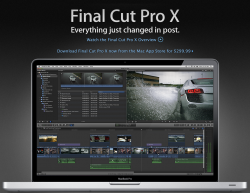 happy with X for video editing.
However, if you are a Final Cut Pro user considering an upgrade you should consider your options very carefully before taking the plunge. Final Cut Pro X is NOT backward compatible with projects created in former version of FCP 7. This is not the tool to purchase if you are already in the middle of a project. Stick with what you have. Luckily, Apple makes that easy to do with their Final Cut Pro 30 day trial version. Having now tried the software myself it is definitely lacking in critical features usually found in pro editing software. Here is a compilation of my own findings and observations from colleagues both on and offline:
- The Reconnect Media function is gone because there is no built in directory function to determine when media is offline. You will only receive a red screen with an exclamation point. FC X functions much more like iMovie and expects that the files exist internally. (Note that once the correct drive is reconnected FC X will automatically reconnect the media)
- As mentioned, prior versions of projects cannot be opened.
- No support for layered Photoshop files.
- The color correction tool has been dumbed down from the prior version.
- The multicam tool is gone. (Note: Apple has acknowledged this and states it will be restored via a Final Cut Pro X update)
- Not possible to reorganize the project media. “Events” are used in a similar way to iMovie but this works better for home movies not a professional production. (Note that by learning to tag footage by keywords it IS possible to reorganize project media. But it’s a new way of working and thinking about footage.)
- OMF and XML export are gone. It’s not possible to send projects to Apple’s own software (for example to Motion). (Note: You can use third party apps such as Automatic Duck to achieve this)
- Not able to customize Quicktime movie export settings. (You must buy Compressor as an add-on for $50 to achieve this. Compressor is no longer bundled with Final Cut Pro X)
- Not able to assign audio tracks. Trackless editing is faster at first but if you are sending files out for professional mixing the tracks must be assigned so the audio engineers can work with them (for example one track is narration, one sound fx, one music, etc.)
- There is no capture from tape function or edit to tape (with the exception of Firewire). (For most this won’t be an issue since tape is a dead format)
- Despite the overhaul there is still no final cut for windows but this is not overly surprising. Final cut pro for Windows is unlikely to ever be produced unless Apple undergoes a drastic strategy change.
- Remember that there are numerous Final Cut plugins that either exist currently or will be released shortly that fill the pro video editing shortcomings remaining.
Download Final Cut Pro X and try it. Choose a 30 day window of opportunity when you are not getting married/moving/having a baby/planning an uprising, etc.. Put FC X through its paces. You only get one trial, use it wisely.
If you are still considering your options, I leave you with the following:
Final Cut Pro vs iMovie
If you are serious about moviemaking you will not be disappointed with FCX. iMovie is an easy video editing software to use, but pay out a couple hundred more bucks and you are bound to be happy with the extra features of FCX.
Final cut pro vs Adobe Premiere 5.5 (around $599)
Premiere has become a reliable piece of professional editing software over the past five years. But its interface is quite different from Final Cut, so you will still face a learning curve. That said, it may be a viable Final Cut Pro alternative for some. Ironically Premiere can import old Final Cut Pro projects. Also, if you are a frequent After Effects user, Premiere offers a better, more streamlined interface. Adobe Premiere also offers a trial which you can download here.
Final Cut pro vs. Avid (around $999)
Avid credits itself with creating the desktop digital editing marketplace having been founded back in the late 1980s. It is still used by the majority of feature film and many TV editors but it lost market share to the less expensive and easier to use FCP. With the new FCX leading to disgruntled users, Avid is extending a financial olive branch, dropping their price from over $2K to $999 (the old price of Final Cut Pro) in the hopes of gaining market share from competing editing softwares. Avid has its own language which is quite different from Premiere or Final Cut Pro. However it is a powerful piece of software and while I’m not personally adept at using it, I have sat with editors in awe at the ease with which they can quickly perform complex editing functions with the adept tapping of a few keys. Luckily, Avid also offers a 30 day free trial.
In the end, the best video editing software is the one that allows you to get the job done creatively in the shortest amount of time. Top video editing programs such as Avid, Premiere and Final Cut Pro have remained on top because of the feature sets they offer. Apple has absolutely done damage to their pro reputaion in this regard, but if they act quickly to communicate and provide users with meaningful updates Final Cut X may just be able to hang onto its top spot. It is by far the cheapest editing software in its class and in that regard it now holds a unique position (especially considering the many final cut pro plug ins available). If it’s true (as some say) that Apple is moving away from pro users to a wider consumer niche, other companies will move in to fill the gap for high end users and the every day consumer will reap the benefits of cheap, feature filled editing software.